MAHATMA GANDHI

$15000

ONE OF THE FINEST CONTENT GANDHI LETTERS ON THE MARKET REGARDING NON-VIOLENCE


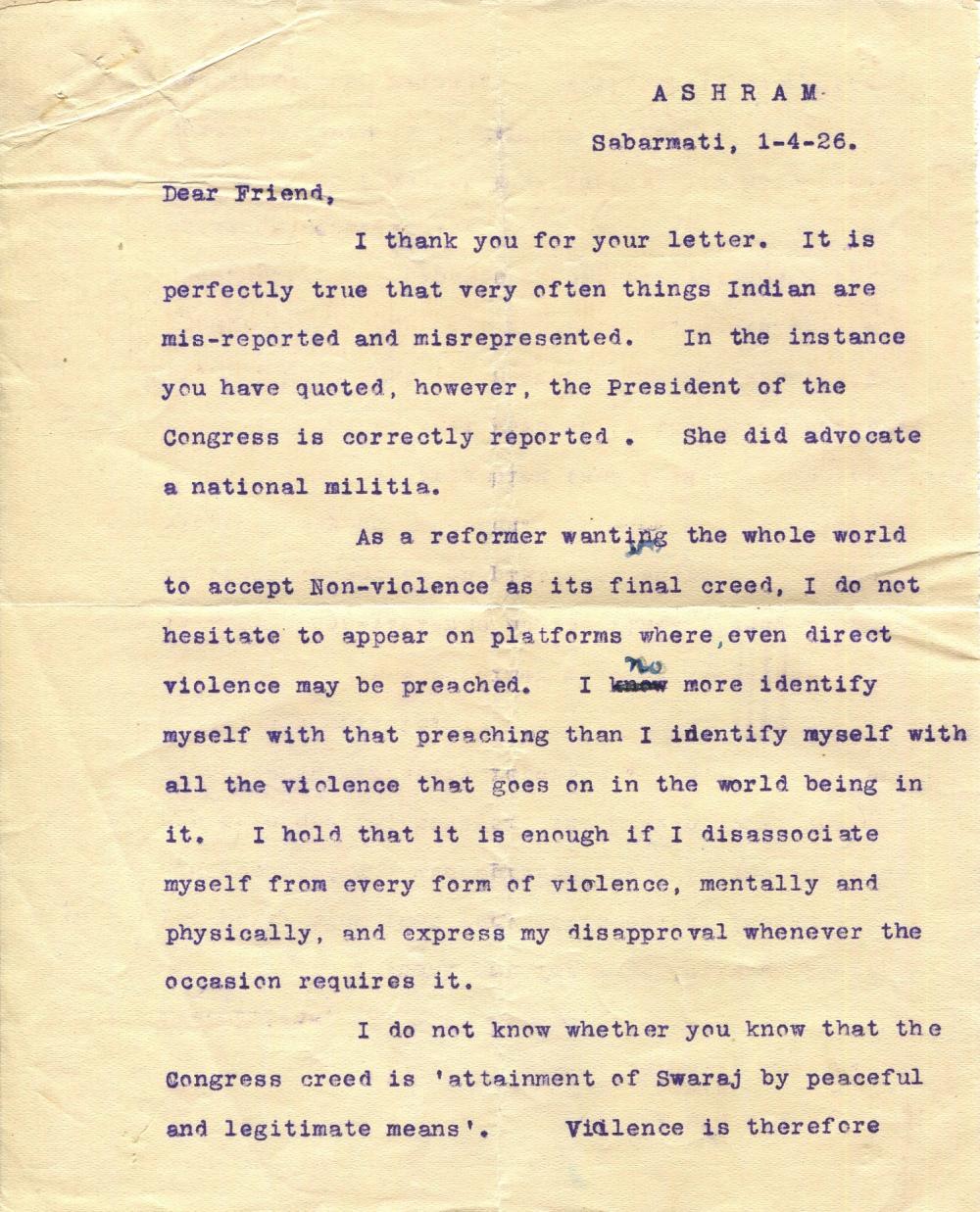
GANDHI MAHATMA: (1869-1948) Indian political and spiritual leader during the Indian independence movement. An excellent T.L.S., M K Gandhi, two pages (separate leaves), 8vo, Sabarmati Ashram, 1st April 1926, to A. Bush Esq., (´Dear Friend´). Gandhi thanks his correspondent for their letter and agrees that it is perfectly true that very often Indian matters are mis-reported, although in the instance his correspondent had quoted the President of the Congress had been correctly reported, and she had advocated a national militia. Gandhi continues to explain ´As a reformer wanting the whole world to accept Non-violence as its final creed, I do not hesitate to appear on platforms where even direct violence may be preached. I no more identify myself with that preaching than I identify myself with all the violence that goes on in the world being in it. I hold that it is enough if I disassociate myself from every form of violence, mentally and physically, and express my disapproval whenever the occasion requires it´, and further states ´I do not know whether you know that the Congress creed is ´attainment of Swaraj by peaceful and legitimate means´. Violence is therefore eschewed in its entirety in the national programme. But I must at the same time own that it does not mean that on the Congress platform people may not advocate the formation of a national militia for purposes of defence. From my own standpoint, a national militia is not necessary, but people who do not believe in Non-violence as their final creed cannot possibly be made non-violent. The spread of non-violence depends upon cultivation of public opinion. Personally I am satisfied that that spirit is daily growing in spite of appearances to the contrary´. Accompanied by the original envelope. A letter of significant content. Some light age wear and a couple of small pinholes to the upper left corner of each page, otherwise VG

In December 1925 the Indian political activist and poet Sarojini Naidu (1879-1949) succeeded Gandhi to become the first-ever Indian woman to be elected President of the Indian National Congress. In that same month Naidu made her historic Presidential Address at the 40th annual session of the Indian National Congress in Kanpur, calling for the formation of a national militia by voluntary conscription. This was not a call for an aggressive army to attack the British, but rather a self-defense force. Naidu believed a self-governing nation (Swaraj ) needed the practical infrastructure to protect its borders and maintain internal peace without relying on British troops. Naidu’s speech highlighted a fascinating internal debate within the independence movement. While she was a loyal follower of Gandhi’s Satyagraha (non-violent resistance), she was also a political pragmatist.
Related Collection Items

Sorry, no other collection items in this category ...

FAQ

Authenticating an autograph is a complex process that entails numerous factors such as the paper, ink, and penmanship. Comparing these elements to known examples is crucial in determining authenticity. If you lack experience in this area, it is highly recommended that you seek the assistance of professionals who can handle the task with expertise.

The value of an autograph is influenced by various factors, including rarity, condition, content, and association. Accordingly, assigning a general value to letters can be challenging. This uniqueness is what adds thrill to autograph collecting and makes pricing a demanding task.

The autograph market is subject to fluctuations like any other market and is sensitive to factors such as supply, demand, and the overall state of the economy. The autograph market differs from other markets as the availability, or supply, of autographs stops after an individual’s death. With the growth of the internet increasing the number of collectors and erasing geographical boundaries, there has been an upsurge in demand for autographs worldwide. Due to ongoing demand and limited supply, autograph prices have inevitably risen over the years, as witnessed by the Brams Collection. It is not advisable to invest in autographs for financial gain, as the autograph market is not especially “liquid” and does not pay dividends. Nevertheless, we believe that autographs are a stable financial investment that should increase in value over time. However, the rate of increase cannot be predicted or guaranteed with precision.

We have a vast collection of autographs and items that are currently not uploaded on our website. If you do not find what you are looking for, please get in touch with us and we will be delighted to search our inventory for you.

Many advise collectors to specialize in a particular area of interest. However, your collection should provide you with personal satisfaction, and not focus solely on making a profitable investment or following the current trend. Always aim for top-quality pieces within your budget, recognizing that items not reaching your standard will remain mediocre. As a collector, it is essential to understand the market and ask pertinent questions before purchasing. Forming a trusted relationship with dealers can help them find desirable pieces to add to your collection.

At Brams Collection, we pride ourselves on our extensive collection of authentic source materials. Our founder, Daniel Brams, is an expert in ink, paper, and penmanship, and has a deep understanding of the history of autographs and authentication techniques. We offer an unconditional guarantee of authenticity to the original purchaser, with no time limit. In addition, we promise competitive prices, prompt and courteous service, and a satisfaction guarantee.

If you have conducted a thorough search using accurate spelling of the name or subject, and are unable to locate the item you desire, please reach out to us via our contact page. Our team will diligently search our inventory for autographs or items that may align with your interests.

We accept a variety of payment methods including VISA, MasterCard, American Express, Discover, PayPal, debit cards, wire transfers, U.S. money orders, and checks drawn on American banks. For new customers, payment for purchases will be requested in advance. Existing clients are typically invoiced with a net 30-day payment term.